


How Long Does a Move Take? How Movers Estimate Moving Time | Ottawa Pro Movers
One of the first questions people ask when planning a move is also one of the hardest to answer with a single number:
“How many hours will my move take?”
It is understandable. If you're hiring movers in Ottawa, you probably want to know how long the truck will be at your home, how much labour you'll be paying for, and whether your move will be finished in the morning or take most of the day.
But professional movers don't simply look at the number of bedrooms and guess.
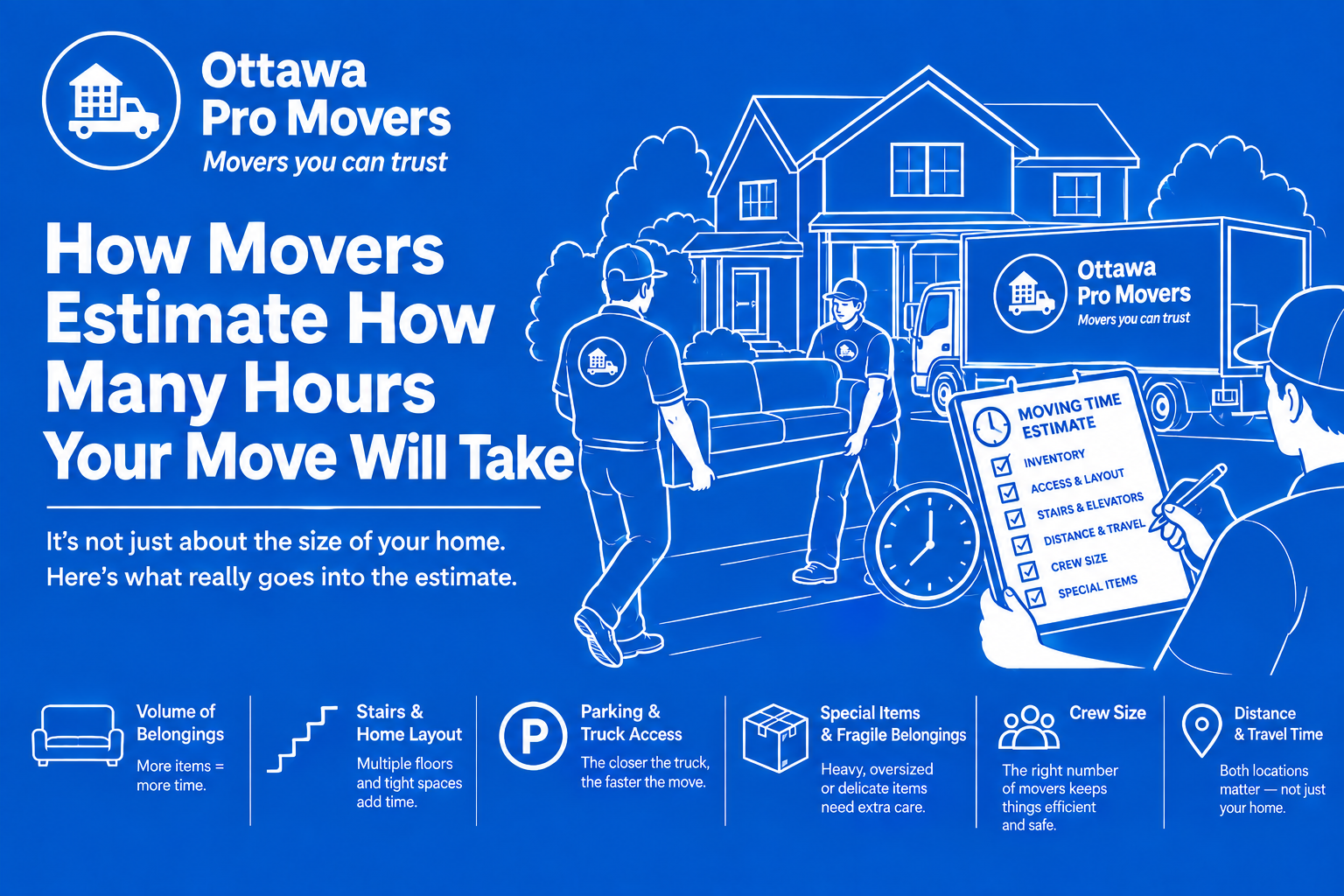
Estimating moving time is more like putting together a puzzle. Movers consider the amount of furniture and boxes, the layout of the home, stairs, elevators, parking, the distance between the truck and the entrance, the number of movers, travel time, and even how well everything is prepared before the crew arrives.
The more accurately those pieces are understood, the more realistic the moving estimate can be.
It Starts With the Amount of Stuff You're Moving
The biggest factor in determining how long a move will take is usually the volume of belongings.
This may sound obvious, but volume isn't necessarily connected to the size of your home. A small two-bedroom apartment can be packed with furniture, boxes, storage bins, and appliances. Meanwhile, someone living in a much larger home may have relatively few belongings.
That's why movers don't only ask, “How many bedrooms do you have?” They want to understand what is actually inside those bedrooms and everywhere else.
A moving company may consider the furniture in your living room, dining room, bedrooms, kitchen, basement, garage, office, and storage areas. The number of boxes also matters because every box has to be carried, loaded, secured in the truck, unloaded, and brought into the new property.
In other words, movers are estimating the amount of physical work, not simply the size of your house.
Furniture Can Change the Estimate Quickly
Imagine you have a three-bedroom home.
If the bedrooms contain beds, dressers and nightstands, the furniture is relatively straightforward. But what if the home also has a large sectional, oversized dining table, several bookcases, a home office, exercise equipment, multiple appliances and a fully furnished basement?
Suddenly, the same “three-bedroom move” represents a much larger job.
Large and awkward furniture can also take more time than several smaller pieces. A sectional that needs to be carefully maneuvered around a staircase may require much more effort than a collection of boxes that can be carried directly to the truck.
This is why providing a detailed moving inventory can make the estimate much more useful.
The Layout of Your Home Matters
Once movers understand what you're moving, they need to think about how they're going to get it out of the house. A home with everything on one level and a driveway directly beside the entrance is relatively straightforward.
Now picture the same amount of furniture in a home with a basement, narrow hallways, multiple staircases and a long walkway to the street. The inventory hasn't changed. The amount of work has.
Stairs are particularly important because furniture and boxes have to be carried vertically rather than simply moved across a floor. Tight corners, narrow doorways and unusual layouts can also slow down the process.
This is one reason an experienced moving company may ask questions about your home's layout before estimating the number of hours required.
The Distance From Your Door to the Truck
Here's a factor many customers don't think about until moving day: where can the truck actually park?
If the moving truck can pull directly into your driveway, the crew may be able to move items efficiently between the house and the truck. But if the truck has to park farther away, every piece of furniture and every box has to travel that additional distance. Consider moving 100 boxes. Carrying each box an extra 30 or 40 metres might not seem like much when you look at one box. Multiply it across the entire move, however, and that additional walking can add a surprising amount of time.
This is why parking and truck access can be an important part of a moving time estimate, particularly in busy Ottawa neighbourhoods, apartment buildings and downtown areas.
Stairs and Elevators Add Another Layer
Stairs are one thing. Elevators create a different set of considerations.
If you're moving out of a condo or apartment building, movers may need to work within a specific elevator reservation or building time window. There may also be a loading dock, long hallway, underground parking area or other access restrictions.
A move involving an elevator can therefore take longer even if the actual amount of furniture isn't particularly large. The same applies to the destination.
Movers don't only calculate how long it will take to get your belongings out of the old home. They also need to consider how they'll get everything into the new one.
The Number of Movers Affects the Time
The size of the crew is another important part of the calculation.
A move with two movers will naturally have a different workflow from a move with three or four movers. But more movers doesn't automatically mean that every move will take proportionally less time. The crew needs enough people to handle the furniture safely and efficiently, while also making sure the number of movers makes sense for the size and complexity of the job. For example, a very heavy piece of furniture may require several movers even if the rest of the move is relatively simple.
The goal is to find the right balance between crew size, safety, efficiency and the amount of work involved.
Heavy and Awkward Items Take More Time
Not every piece of furniture is created equal.
A box of clothing can be carried quickly. A large refrigerator, safe, treadmill or oversized sectional requires a completely different approach. Movers need to consider the item's weight, size, shape and accessibility. They may also need to determine whether something should be disassembled before it can safely leave the property. If you have particularly heavy or oversized items, mentioning them when requesting your moving estimate is important. A mover who knows about them ahead of time can plan the crew and equipment accordingly instead of discovering the challenge when the truck arrives.
Disassembly and Reassembly Are Part of the Moving Time
Sometimes furniture can't simply be picked up and carried away.
Beds may need to be disassembled. Large tables may need their legs removed. Shelving units, desks and other furniture may need to be taken apart to get through narrow doors or staircases. If those items are being reassembled at the destination, that takes additional time as well.
This doesn't mean you should disassemble everything before the movers arrive. Depending on the service you're hiring, professional movers may be able to handle the disassembly and reassembly themselves. The important thing is that the moving company knows what is involved so it can build that work into the estimate.
Packing Can Significantly Change Moving Time
There is a major difference between arriving at a home where everything is already packed and arriving at a home where the kitchen is still full of dishes and the closets are still being emptied.
Packing and moving are two separate tasks, and packing can add substantial labour time. Even when a customer plans to pack independently, the movers still need to handle all those boxes once they are ready to go. That`s why the number of boxes and the state of preparation on moving day can have a direct impact on the total time.
A home that is completely packed, organized and ready for the movers is generally easier to load than one where the crew has to wait for items to be packed or cleared.
Travel Time Is Part of the Move
For a local Ottawa move, movers also need to consider the distance between the pickup and delivery addresses.
The crew isn't only working while carrying furniture. The truck also needs to travel from one location to another. Traffic, road conditions and the distance between the two properties can therefore affect the overall duration of the move. For long-distance moving, transportation becomes an even larger part of the calculation. The moving company needs to consider the distance between cities, driving time, scheduling and the logistics of getting the shipment from the origin to the destination.
So when you're asking, “How many hours will my move take?”, it's important to clarify whether you're talking about labour time, travel time, or the total time from start to finish.
Why Your Moving Estimate Is an Estimate
Even with careful planning, moving companies can't predict every minute of a move.
A dresser might turn out to be more difficult to maneuver than expected. An elevator might be delayed. Traffic could be heavier than usual. A piece of furniture may require unexpected disassembly. This is why a moving estimate should be viewed as a realistic projection rather than a guarantee that the job will finish at exactly a particular minute.
Experienced movers use the information available to them to create the most reasonable estimate possible. The more accurate the information you provide, the more useful that estimate becomes.
What Can You Do to Get a More Accurate Moving Time Estimate?
You don't need to become a moving expert to help your movers estimate the job. Start by giving them an honest picture of what you're moving.
If your basement is full, mention it. If you have a garage packed with boxes, mention it. If there are three flights of stairs, an elevator reservation, a long driveway or limited parking, make sure the moving company knows. Don't forget large and heavy items.
And if you are still packing, give the movers an approximate idea of how many boxes you expect to have. Saying “we'll probably have around 50 boxes” is much more useful than leaving the number completely unknown. For larger or more complicated moves, an in-home or on-site estimate can be especially helpful because the moving company can see the furniture, access and layout for themselves.
Why Two Moves That Look Similar Can Take Different Amounts of Time
This is perhaps the most important thing to understand about moving estimates.
Two customers can both say: “I'm moving from a three-bedroom house.” One move might take only a few hours. The other might take considerably longer.
The difference could be the number of belongings, the amount of furniture, stairs, parking, distance to the truck, a basement or garage, heavy items, packing, or simply the layout of the properties. The bedroom count gives movers a starting point. The details of the move determine the timeline.
Planning Ahead Makes Moving Day Easier
One of the best ways to keep your moving day on schedule is to prepare before the movers arrive.
Have your boxes packed and properly closed. Make sure pathways are reasonably clear. Finish last-minute sorting before the crew arrives. Confirm elevator reservations or building requirements if applicable, and make sure the movers know about anything unusual.
Good preparation doesn't just make the day less stressful for you. It allows the crew to spend their time doing what you hired them to do: moving your belongings safely and efficiently.
Estimating how many hours a move will take isn't as simple as counting bedrooms.
Professional movers look at the entire picture - the volume of belongings, furniture, boxes, stairs, elevators, parking, truck access, heavy items, disassembly, crew size, travel distance and the accessibility of both properties.
That's why providing detailed information when requesting a moving quote can make such a difference.
At Ottawa Pro Movers, we believe the best moving experience starts with good planning. Whether you're moving across Ottawa, relocating to another city, or simply moving a few streets away, understanding the details of the job allows us to plan the appropriate crew, truck and services.
Because when you know what goes into calculating moving time, you can plan your moving day with much more confidence.