


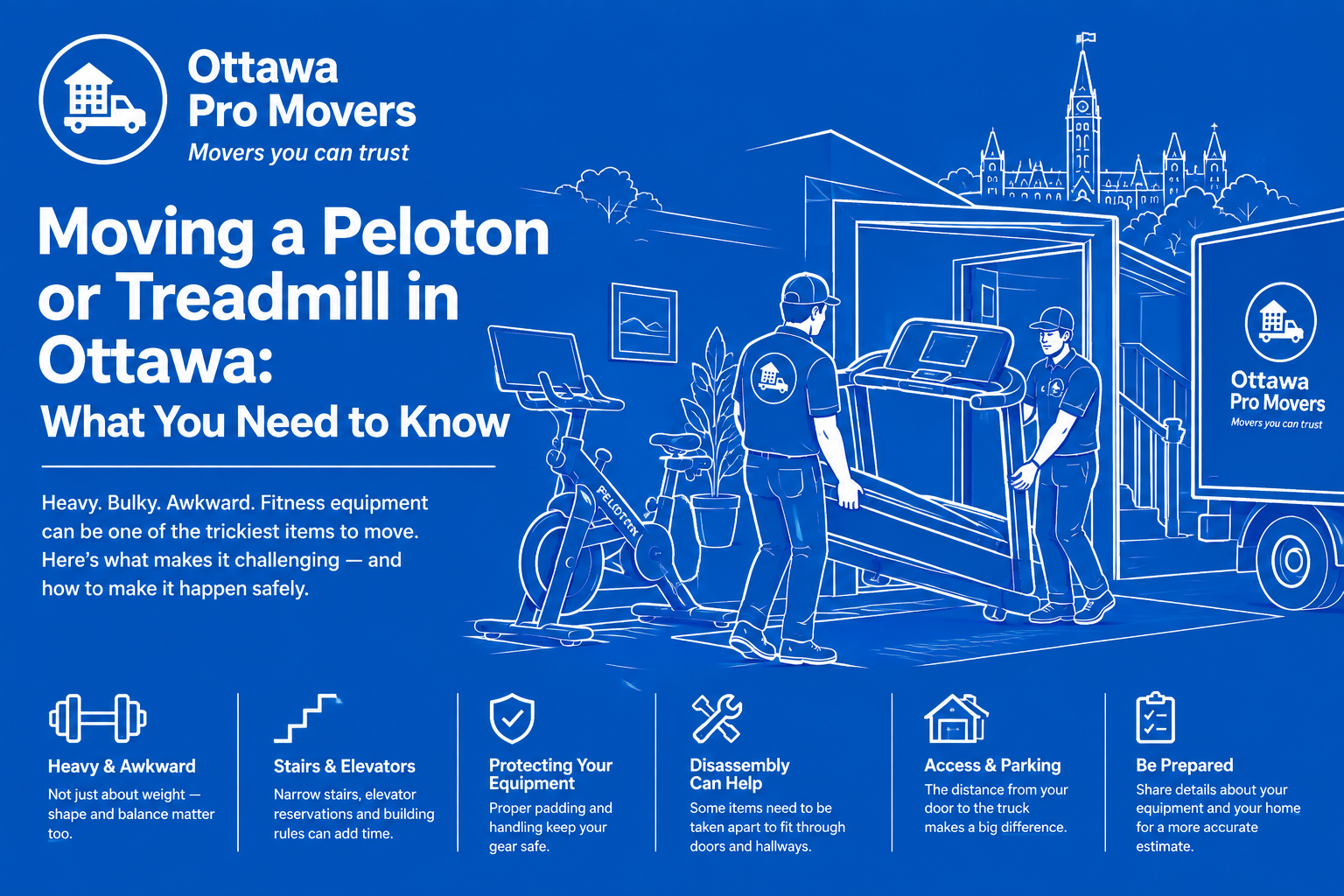
Moving a Peloton, Treadmill or Home Gym in Ottawa: What Makes These Items Difficult to Move?
Moving day usually involves a familiar routine. Movers wrap the furniture, carry boxes, load the truck, and carefully secure everything for transportation.
Then there is the treadmill.
Or the Peloton.
Or that home gym you bought with the intention of using every single day.
Suddenly, moving a few pieces of furniture becomes a very different challenge. Large fitness equipment can be some of the most awkward items to move from one home to another. They are heavy, difficult to grip, often made up of delicate components, and can be surprisingly difficult to maneuver through doorways, hallways, staircases, and elevators.
If you're planning to move a Peloton, treadmill, elliptical, weight bench, or home gym in Ottawa, understanding what makes these items challenging can help you prepare for moving day and choose the right moving service.
Why Is Fitness Equipment So Difficult to Move?
At first glance, a treadmill or exercise bike might not seem particularly complicated. It doesn't have the same shape as a large sectional sofa, and it may even be smaller than some pieces of furniture.
The problem is that fitness equipment combines several difficult characteristics at once. It can be heavy, awkwardly shaped, difficult to grip, and sensitive to damage. Some machines also have moving parts, screens, cables, motors, weights, or electronic components that require careful handling.
A treadmill is a perfect example. The frame may be relatively easy to understand, but the machine can be bulky and difficult to carry. Its weight isn't always distributed evenly, and the shape can make it awkward to maneuver around corners or down stairs. Now add a narrow staircase to the situation, and a simple piece of home equipment can quickly become one of the most challenging items in the house.
Moving a Peloton Requires More Than Two People Carrying a Bike
Exercise bikes are generally easier to handle than large treadmills or multi-station home gyms, but that doesn't mean they're automatically easy to move.
A Peloton, for example, contains a combination of a heavy frame, moving components, pedals, handlebars, and an electronic display. The screen deserves particular attention. During a move, equipment shouldn't simply be grabbed and carried by whatever part is easiest to reach. Movers need to think about where pressure is being applied, how the machine will be lifted, and how it will be protected during transportation. Depending on the model and the moving situation, certain components may also need to be removed or secured before the bike is transported.
The goal is not just to get the bike from one room to another. It needs to arrive at the destination in the same condition it was in before the move.
Treadmills Are Awkward Because of Their Shape
Treadmills create a different problem. They are long, relatively heavy, and difficult to hold from a comfortable position. Even when the running deck folds, the equipment can remain bulky.
A treadmill also needs to be maneuvered rather than simply carried in a straight line. Think about the path from a basement to the front door. There may be a staircase, a tight corner, a doorway, and another turn before the equipment even reaches the truck. The movers have to work out the safest way to navigate that path without damaging the machine, walls, floors, or railings.
This is why moving a treadmill down stairs is very different from moving a few boxes of clothing.
Your Basement Can Make the Job Much Harder
Many home gyms are located in basements.
That makes sense when you're designing a workout space, but it can create a challenge when it's time to move.
A basement may have a lower ceiling, narrow stairs, tight corners, or limited access to the outside. Some homes also have basement entrances that aren't suitable for large moving equipment. A treadmill that was easy to bring into the basement when the house was empty can be much more difficult to remove once the room is furnished and the staircase is surrounded by walls and railings. Movers have to consider the entire route.
Where can the equipment be safely picked up? Which direction should it face? Can it make the turn at the bottom of the stairs? Is there enough clearance at the top? Where will the truck be parked? These questions are part of the moving plan.
Weight Isn't the Only Issue
When people think about moving fitness equipment, they often focus on weight. Weight definitely matters, but shape and maneuverability can be just as important.
A heavy box with handles can be relatively straightforward to carry because the movers have something to grip. A large piece of fitness equipment may have no convenient lifting points. Its weight can be distributed across a long frame, while the machine itself may be difficult to keep balanced. That's why two items weighing the same amount can require completely different moving techniques.
Professional movers look at the equipment as a whole rather than relying on the weight alone.
Home Gyms Can Become a Collection of Difficult Items
A home gym isn't always one piece of equipment.
Over time, a workout room can accumulate a treadmill, exercise bike, elliptical, adjustable bench, free weights, dumbbells, weight plates, squat racks, mirrors, storage units, and other equipment. Individually, some of these items may be relatively manageable. Together, they can create a significant moving job.
Weights are especially easy to underestimate. A collection of dumbbells and plates can represent a substantial amount of weight, and they need to be packed and transported appropriately rather than simply thrown into random boxes.
The same applies to weight machines that contain multiple plates, cables, pulleys, frames, or other components.
Disassembly Can Make a Big Difference
Sometimes the best way to move a large piece of fitness equipment is to make it smaller first.
Depending on the equipment, this may involve removing handles, screens, pedals, arms, weight plates, benches, or other components. Disassembly can make it easier to navigate narrow doorways and stairs while also reducing the risk of damaging the equipment or the property.
But there's an important distinction between simple furniture disassembly and complicated equipment disassembly. If an item has electrical components, complicated mechanisms, tensioned cables, or manufacturer-specific assembly requirements, it may be better to follow the manufacturer's instructions or have an appropriate technician handle certain parts.
A professional moving company can focus on safely transporting the equipment, while specialized technical work may require a different professional.
Protecting the Equipment and Your Home
Fitness equipment can be heavy enough to damage flooring or walls if it isn't handled carefully.
A treadmill being moved around a corner can easily come into contact with a wall. A metal frame can scratch a floor. A dropped weight can cause significant damage. That's why proper protection is an important part of moving heavy exercise equipment. Movers may use moving blankets, padding, straps, floor protection, and other appropriate equipment to protect both the item and the property.
The route itself should also be considered. Before moving day, it's helpful to make sure the pathway is clear of smaller furniture, boxes, decorations, and other obstacles. Giving movers enough room to maneuver can make a difficult item considerably easier to handle.
Stairs Are Where Planning Really Matters
A treadmill or home gym on the main floor is one thing. A treadmill in a basement is another. When stairs are involved, movers need to think about the equipment's dimensions, weight distribution, staircase width, ceiling height, corners, railings, and the available space for the crew. This is where trying to move heavy fitness equipment yourself can become particularly risky.
A machine that feels manageable when you're standing beside it can become much harder to control once you're on stairs. Professional movers can assess the route ahead of time and determine how the equipment should be handled based on the specific property.
What About Elevators?
Ottawa has plenty of condo and apartment buildings where fitness equipment needs to travel by elevator. The equipment may fit inside the elevator, but that doesn't necessarily mean the move is straightforward.
The movers may need to work within a scheduled elevator reservation. Building rules may limit the hours when a move can take place. The loading area may be some distance from the entrance, and the equipment may need to travel through a long hallway before reaching the elevator. All of these factors can affect the time required.
If you're moving a treadmill or Peloton from a condo, it's a good idea to tell your moving company about the elevator and building requirements before moving day.
Don't Forget About the Truck
Once the equipment gets outside, the job isn't finished.
Large fitness equipment needs to be loaded securely inside the moving truck so that it doesn't shift during transportation. A moving truck isn't just a large empty room. Everything inside needs to be positioned and secured properly. Movers need to consider the equipment's size, where it can safely be placed, and how other belongings will be loaded around it. This is particularly important for heavy items because you don't want a treadmill or weight machine shifting into lighter furniture during transportation.
Moving Fitness Equipment Across Ottawa
For a local Ottawa move, the distance between your old and new home may be relatively short, but the logistics can still matter.
A treadmill moving from a basement in Barrhaven to a condo in downtown Ottawa may have completely different access requirements than a Peloton moving from one suburban home to another. The same piece of equipment can therefore require a different moving approach depending on the properties involved.
This is one reason it's useful to give your moving company details about both the pickup and delivery locations. The destination matters just as much as the starting point.
Should You Move Your Fitness Equipment Yourself?
It depends on the equipment and the circumstances.
A small exercise bike may be manageable for some people with the right vehicle and enough help. A large treadmill, multi-station home gym, or heavy collection of weights is a different story.
Before deciding to move something yourself, consider not just whether you can lift it, but whether you can safely get it through the entire route — including stairs, corners, doorways, elevators and loading areas. You also need to consider whether you have the appropriate vehicle, straps, padding and number of people required to handle the equipment safely. Sometimes the biggest challenge isn't lifting the machine.
It's getting it around the corner.
How to Prepare Your Fitness Equipment for Moving Day
A little preparation can make a big difference.
If the equipment has manufacturer instructions for transportation or disassembly, review them before moving day. Remove personal items and accessories from the equipment, and make sure small components are kept together. Clear the pathway from the equipment to the exit. If you're moving from a basement, make sure the staircase and landing are free of clutter. For condo or apartment moves, confirm any elevator or loading-area requirements in advance.
Most importantly, tell your moving company exactly what you're moving.
Don't simply say, “I have a treadmill.” If it's an oversized commercial treadmill, a heavy multi-station machine, or part of a complete home gym, that information helps movers plan appropriately.
When You Request a Moving Quote, Mention the Details
Fitness equipment is one of those things that can be easy to forget when describing your inventory. You might remember to mention your sofa, dining table, beds and appliances but forget about the treadmill sitting in the basement. That information matters.
When requesting a moving quote in Ottawa, mention any large or unusually heavy fitness equipment, along with its location in the home. Let the movers know if stairs, elevators, narrow hallways, or difficult access are involved. Photos can also be useful for unusual items because they allow the moving company to better understand the equipment and surrounding space. The more information the movers have before moving day, the easier it is to plan the job.
A Home Gym Doesn't Have to Be a Moving Nightmare
A Peloton, treadmill, or home gym can be challenging to move, but the difficulty usually comes down to planning.
The movers need to understand the equipment, the route, the property, the access conditions, and the best way to protect everything involved. What looks like one large machine from across the room is actually a combination of weight, dimensions, moving parts, fragile components and logistical challenges.
At Ottawa Pro Movers, we understand that not every item in your home can be treated like a standard piece of furniture. When you're moving heavy or awkward fitness equipment, our team can assess the situation, plan the handling process, and work with you to make moving day as straightforward as possible.
Whether you're moving a Peloton in Ottawa, a treadmill from a basement, or an entire home gym, the best place to start is with an accurate description of what you're moving and where it needs to go.
Because sometimes, the hardest part of moving your workout equipment isn't the workout. It's getting it out of the house.