


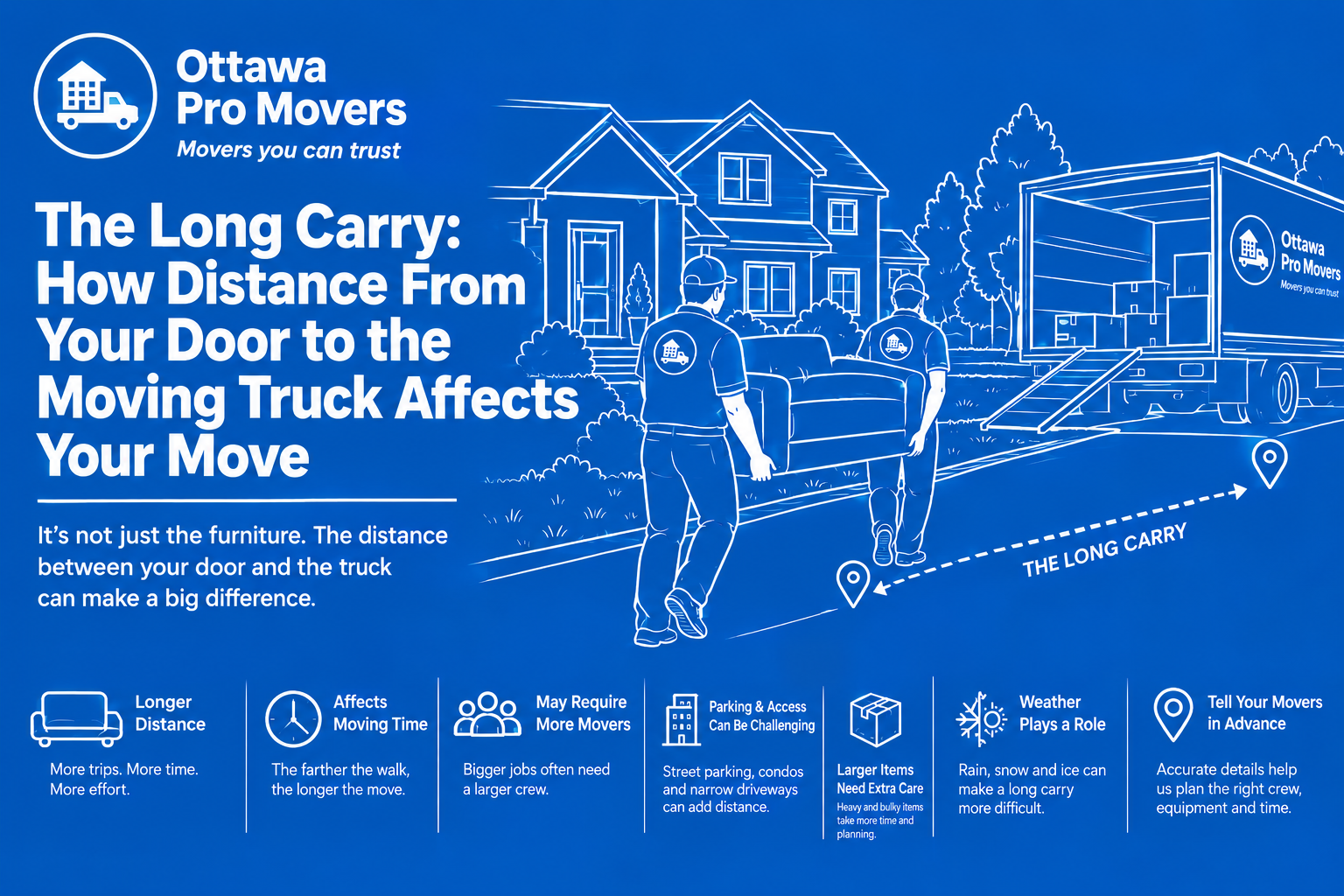
The Long Carry: How Distance From Your Door to the Moving Truck Affects Your Move
When people plan a move, they usually think about the big things: how many bedrooms they have, how much furniture needs to be moved, and how far they are travelling to their new home.
But there is one small detail that can make a surprisingly big difference on moving day: the distance between your front door and the moving truck.
Professional movers call this a long carry. It describes a situation where movers have to carry furniture and boxes over a longer-than-usual distance between the property and the truck. It might happen because the driveway is long, street parking is the only option, the building has a distant loading area, or the truck cannot get close to the entrance.
At first, a few extra metres might not seem like much. But when you're moving an entire household, those metres quickly add up. And depending on the property, a long carry can affect how long your move takes, how the crew plans the job, and sometimes how much the move costs.
If you're preparing for a move in Ottawa, understanding how long carries work can help you plan ahead and avoid surprises.
What Exactly Is a Long Carry?
Imagine moving out of a house where the moving truck can park directly beside the garage. The movers can carry furniture and boxes a short distance before loading everything onto the truck.
Now imagine a different situation. The driveway is too narrow for the truck, so it has to park on the street. The front entrance is around the side of the house, and the crew has to walk down a long path to reach the truck.
The amount of furniture hasn't changed. The number of boxes hasn't changed. But every item now has to travel farther.
That is a long carry.
The same situation can happen in apartment buildings and condominiums. The truck might need to remain in a designated loading zone, while the movers have to travel through a lobby, along a hallway, or across a parking area before reaching the truck.
In some cases, the distance is unavoidable. In others, a little planning can make the process easier.
Why a Few Extra Metres Can Make Such a Difference
The easiest way to understand a long carry is to think about how many trips a moving crew makes during a typical move.
Movers don't carry everything out of your home in one trip. They move individual pieces of furniture, boxes, appliances, and other belongings one load at a time. Each trip involves walking from the property to the truck, loading the item, and returning for the next one.
Now add an extra 20 or 30 metres to that journey.
One trip might not make a noticeable difference. But if the crew makes dozens or even hundreds of trips throughout the day, that additional walking becomes a significant part of the job.
The effect can be particularly noticeable when moving a large household with many boxes, multiple bedrooms, a basement, or a garage full of belongings.
A longer route means more walking, more time spent transporting each item, and more physical effort for the moving crew.
This is why the distance from your door to the truck can matter almost as much as the amount of furniture you're moving.
How a Long Carry Can Affect Your Moving Time
One of the most common questions customers ask is how long their move will take.
Movers consider several factors when estimating the time required, including the volume of belongings, the number of movers, stairs, elevators, travel time, and the accessibility of both properties.
The distance between the entrance and the truck is another important part of that calculation.
Consider two homes with identical inventories. Both have the same number of boxes, the same furniture, and the same number of bedrooms.
At the first home, the truck parks directly in front of the entrance. At the second, the truck must remain at the far end of a parking lot.
Even though the homes contain the same belongings, the second move may take longer because the crew has to walk farther with every load.
The exact difference depends on the distance, the number of items, the layout, and the moving conditions. There is no universal amount of extra time that applies to every long carry.
However, letting your moving company know about the distance in advance can help it prepare a more realistic estimate.
Parking Is Often the Beginning of the Problem
In Ottawa, parking and truck access can vary considerably depending on the neighbourhood and property type.
A suburban home may have a spacious driveway that allows a moving truck to park close to the entrance. A downtown property might have limited street parking, narrow access, or restrictions on where a large vehicle can stop.
Condominium buildings may have designated loading areas that are not immediately beside the entrance. Some properties also have shared driveways, underground parking, or access routes that are unsuitable for moving trucks.
In these situations, the crew may have to work with the available parking arrangements rather than simply choosing the most convenient spot.
That is why parking is worth discussing when requesting a moving quote. If you already know that the truck cannot park close to your door, mentioning it early can help the moving company account for the additional work.
Long Carries in Condos and Apartment Buildings
Long carries aren't limited to houses.
In fact, apartment and condominium moves can involve several layers of distance.
The truck might be parked outside the building, but the movers still need to reach the unit through the entrance, lobby, hallways, and elevator. If the loading area is on the opposite side of the building, the journey can become even longer.
Elevator access can also affect the process. If movers need to wait for an elevator or work within a reserved time window, the move may require additional coordination.
For example, moving from a condo with a dedicated loading dock and a nearby service elevator can be quite different from moving out of a building where the truck must park on the street and the elevator is a long walk from the loading area.
Both may be described as apartment moves, but the logistics are not necessarily the same.
When arranging your move, it's helpful to tell the moving company about the building's loading arrangements, elevator location, access rules, and any restrictions on moving trucks.
The Type of Belongings Matters Too
Not every item is affected by a long carry in exactly the same way.
Carrying a small box over an additional distance is generally straightforward. Moving a large sectional sofa, a heavy dresser, or a bulky appliance over that same route requires more effort.
Large items can be awkward to maneuver, especially along narrow paths, around corners, or over uneven surfaces. Heavy belongings also require careful handling, regardless of how far they need to travel.
If your home contains oversized furniture, exercise equipment, large appliances, or other heavy items, the moving crew may need to plan the route and handling process more carefully.
The distance is only one part of the picture. The combination of distance, item size, weight, and accessibility determines how challenging the carry will be.
Weather Can Make a Long Carry More Complicated
Anyone who has lived in Ottawa knows that moving conditions can change dramatically throughout the year.
During the summer, a long walk between the house and the truck may simply mean extra time and effort. During winter, snow, ice, and slush can make the same route more challenging.
A long outdoor path may need to be cleared and made as safe as reasonably possible before the movers arrive. Wet or slippery surfaces can make it harder to carry furniture and boxes securely, so the crew may need to take additional precautions.
Rain can also affect how belongings are protected during transportation from the house to the truck.
If you're moving during the colder months, preparing the walkway, driveway, and entrance can help make the process smoother. Clearing snow and ice from the route is especially important when heavy furniture is involved.
A safe path is not just about saving time. It also helps protect your belongings, your property, and everyone involved in the move.
Does a Long Carry Always Mean a Higher Moving Cost?
Not necessarily. The answer depends on the moving company's pricing structure and the terms of your quote.
For an hourly move, a long carry may increase the total cost if it adds time to the job. If the crew spends longer transporting items between the home and the truck, the overall labour time may increase.
Some moving companies may also have specific policies regarding long carries or difficult access. If those conditions apply, they should be explained clearly before the move.
For a fixed-price move, the effect may be different. The company may account for the expected carrying distance when preparing the quote, provided it has been given accurate information about the property.
This is why it's important to understand what your moving estimate includes. Rather than assuming every company handles long carries the same way, ask whether the quote accounts for the actual truck access and distance involved.
A good estimate should reflect the circumstances of your move as accurately as possible.
Can You Reduce the Impact of a Long Carry?
Sometimes, yes.
The first step is to find out whether the truck can legally and safely park closer to the entrance. If you're moving from a house, check whether the driveway can accommodate the truck and whether there are any access restrictions.
If you're moving from a condominium or apartment building, ask the property manager about the designated loading area and whether arrangements can be made to use the most convenient access point.
In some locations, reserving an appropriate loading space may be possible, subject to local rules and building policies. However, you should never assume that a moving truck can park wherever it is most convenient.
It's also worth making sure the route is clear before the movers arrive. Remove unnecessary obstacles from walkways, hallways, and entrances. During winter, clear snow and ice from the path.
If you have flexibility with the moving date or time, ask your moving company whether a different arrival window could improve access or parking conditions.
These steps won't eliminate every long carry, but they may help make the route more manageable.
Why You Should Tell Your Movers About Access in Advance
One of the most helpful things you can do when requesting a moving quote is to describe the property accurately.
Don't just provide the address and the number of bedrooms. Explain where the truck is likely to park and how far it will be from the entrance.
If you're moving from a house with a long driveway, mention it. If your condo has a loading dock on the opposite side of the building, let the company know. If the movers need to cross a large parking area or walk through several hallways, that information can be useful too.
Photos can also help when the access situation is unusual. A picture of the driveway, entrance, or loading area may give the moving company a clearer idea of what to expect.
The more your movers know before moving day, the easier it is to plan the job, estimate the required time, and prepare the appropriate crew.
The Distance at Your New Home Matters Just as Much
It's easy to focus on the pickup location when planning a move, but the destination deserves the same attention.
Even if the truck can park close to your current home, your new property might have limited parking, a long walkway, or a building entrance that is far from the loading area.
This means the crew could experience a long carry at the delivery location even if loading at the origin is straightforward.
For an accurate moving estimate, both addresses need to be considered.
When discussing your move with a moving company, explain the access arrangements at the pickup and delivery locations separately. The two properties may have very different requirements, and both can affect the moving process.
A Little Planning Can Make a Big Difference
A long carry may seem like a minor detail when you're organizing a move. Compared with packing an entire house or transporting furniture across the city, an extra distance between the door and the truck might not seem particularly important.
But moving is made up of hundreds of individual tasks. Small logistical challenges can add up, especially when they affect every trip the crew makes.
Understanding the carrying distance helps you see why moving estimates depend on more than the number of rooms in your home or the distance between two addresses.
The amount of furniture matters. The layout matters. Parking matters. And sometimes, the distance between your front door and the truck matters more than you might expect.
At Ottawa Pro Movers, we believe good planning starts with understanding the details of each move. Whether you're moving from a suburban home, a downtown apartment, or a condominium with a designated loading area, knowing about access conditions in advance helps us plan for the work involved.
If you're preparing for a move in Ottawa, mention any long walkways, parking limitations, or difficult access points when requesting your quote. It may seem like a small detail, but it's exactly the kind of information that can help make your moving day more predictable.
After all, moving isn't just about getting your belongings from one address to another. It's about understanding everything that happens between your front door and the moving truck.


