


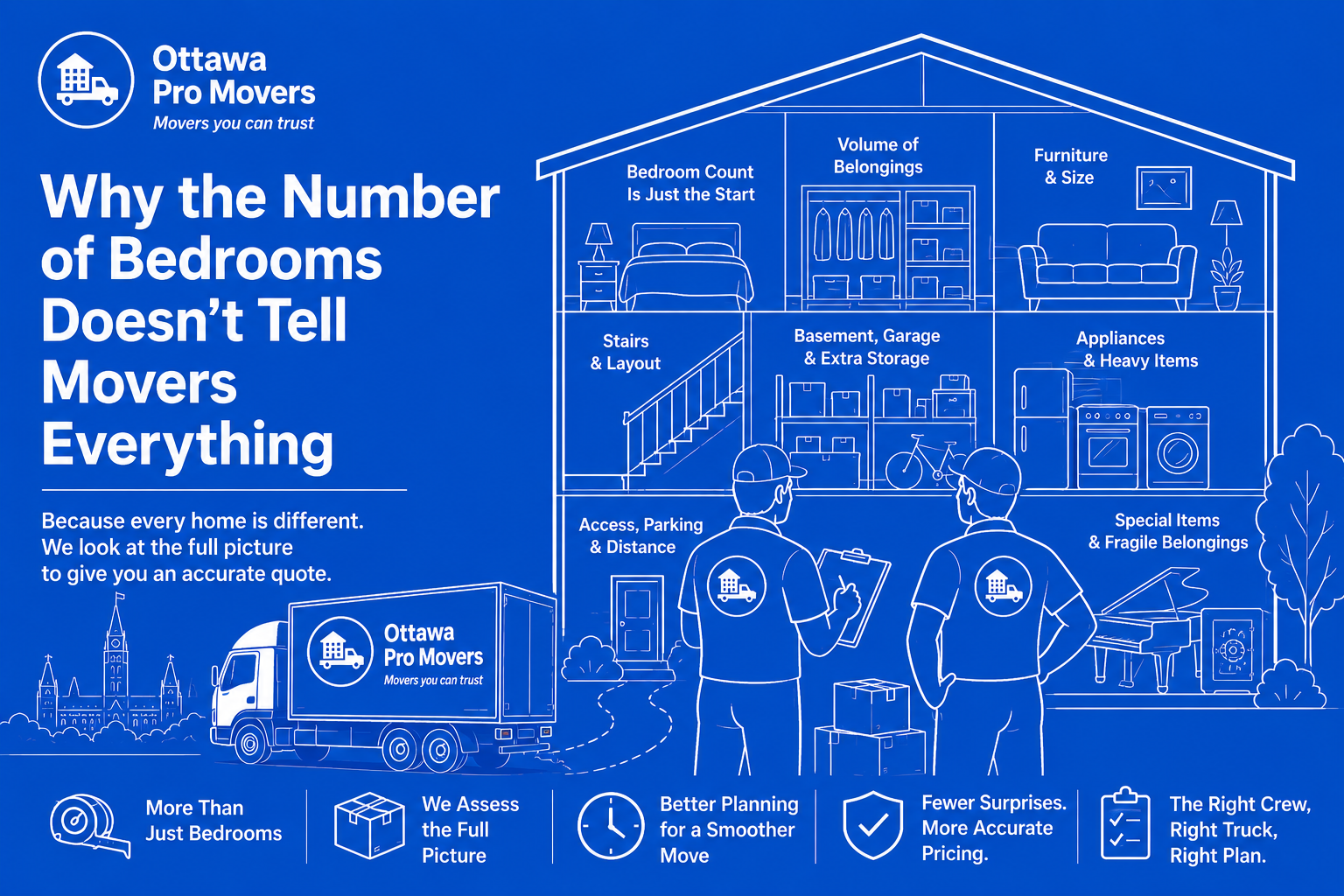
Why the Number of Bedrooms Doesn’t Tell Movers Everything
When someone starts planning a move, one of the first questions a moving company often hears is, “How much does it cost to move a two-bedroom or three-bedroom home?”
It sounds like a reasonable way to estimate a move. After all, a three-bedroom house should require more work than a one-bedroom apartment, right?
Usually, yes, but the number of bedrooms is only a starting point.
In reality, two homes with the exact same number of bedrooms can require completely different amounts of time, labour, truck space, and planning. One three-bedroom home might have minimal furniture and easy access, while another could be packed from the basement to the garage with heavy furniture, appliances, boxes, and years of belongings.
So, when professional movers calculate a moving quote, they look beyond the number of bedrooms.
At Ottawa Pro Movers, we consider the entire move, not just the number on the real estate listing.
A Three-Bedroom Home Can Mean Very Different Things
Imagine two families are moving out of three-bedroom homes in Ottawa.
The first family has lived in their home for only a few years. They have relatively little furniture, no finished basement, a small amount of storage, and a driveway where the moving truck can park right beside the entrance.
The second family has lived in their home for twenty years. The basement is full, the garage is packed, there are large appliances and heavy furniture throughout the house, and the truck has to park some distance from the front door.
Both customers have a three-bedroom home.
But from a mover's perspective, these are two completely different moves. The second home could require significantly more loading time, more labour, more truck space, and more planning. That is why a moving company cannot accurately estimate the cost of a move based only on the number of bedrooms.
What Matters More Than the Number of Bedrooms?
When movers evaluate a home, they are really trying to answer one question: “How much work will it take to safely move everything from here to there?”
To answer that, they consider the overall volume of belongings.
A home with three bedrooms, for example, may also have a living room, dining room, kitchen, office, basement, garage, storage room, and outdoor furniture. Those spaces can dramatically increase the amount of furniture and boxes that need to be moved. This is particularly important because homeowners sometimes forget about the areas that aren't technically considered “rooms.”
The garage might contain shelving, tools, bikes, seasonal decorations, and outdoor equipment. The basement might contain a treadmill, extra furniture, storage bins, and years of accumulated belongings.
All of that counts when estimating a move.
Furniture Matters More Than Square Footage
The size of your home doesn't necessarily tell movers how much furniture you have. A large home with minimalist furniture can sometimes be easier to move than a smaller home filled with large pieces. Movers look at things like sofas, sectionals, beds, dressers, dining tables, desks, bookcases, entertainment units, cabinets, appliances, and other large items. They also consider how those items can actually be moved out of the property. A large sectional might look straightforward in a spacious living room, but if it has to make a tight turn on a narrow staircase, the situation changes quickly. That is why an inventory of your belongings can be much more useful than simply telling a moving company how many bedrooms you have.
Your Basement Can Change the Entire Move
One of the most overlooked parts of a home when estimating a move is the basement. A customer might say, “It's just a three-bedroom house,” without realizing that the basement contains another significant amount of furniture and storage.
Finished basements can include sofas, televisions, desks, exercise equipment, shelving, and entertainment furniture. Unfinished basements often contain storage bins, tools, seasonal items, and other belongings that still need to go on the truck.
And then there is the staircase. Moving items from a basement means carrying everything upstairs before it can even reach the truck. If the staircase is narrow or has difficult turns, that can add even more time. For movers, the basement isn't an afterthought. It is part of the moving plan.
Stairs Can Matter More Than Another Bedroom
Here's another reason bedroom count can be misleading. A two-bedroom home with three flights of stairs can potentially take more labour than a three-bedroom bungalow with everything on one level. Every staircase changes how movers handle furniture and boxes. It affects the physical effort involved and the amount of time required to move items safely.
The same applies to apartment buildings and condos. A relatively small condo move can become more complicated if movers need to use an elevator, reserve a loading area, navigate long hallways, or carry furniture a significant distance between the building and the truck.
This is why accessibility is an important part of a moving estimate.
The Distance to the Moving Truck Matters
It isn't just what's inside your home that matters. Movers also need to know how far the truck can get to your door. If the moving truck can park directly beside the entrance, the crew can move furniture and boxes relatively efficiently.
But imagine the truck has to park at the end of a long driveway or across a parking lot. Every item now has to travel that additional distance. That might not sound significant when you're moving one box. Multiply that distance by hundreds of boxes and pieces of furniture, and it can make a noticeable difference in the total moving time. This is one of those details homeowners may not think about when requesting a moving quote, but experienced movers notice it immediately.
Heavy and Oversized Items Require Extra Planning
A moving estimate also needs to account for items that aren't easy to handle like standard household furniture.
Large appliances, oversized sectionals, safes, pianos, pool tables, heavy exercise equipment, and other unusually heavy or awkward items may require additional planning and equipment. The issue isn't simply how much an item weighs.
Movers also need to consider whether there is enough space to maneuver it, whether it can fit through the doors and hallways, whether it needs to be disassembled, and how many people are needed to move it safely. This is why it is always helpful to tell your moving company about unusually heavy or oversized items before moving day.
The Number of Boxes Can Be a Bigger Factor Than You Think
Furniture usually gets most of the attention, but boxes matter too.
A home with relatively little furniture can still take a considerable amount of time to move if it contains a large number of packed boxes. Think about kitchens, books, clothing, children's rooms, offices, garages, and storage areas. A few boxes from each room can quickly turn into dozens or even hundreds. For a moving company, every box needs to be carried, loaded, secured inside the truck, unloaded, and brought into the destination property.
That is why the volume of belongings is one of the most important factors in determining how long a move will take.
The Number of Movers Is Part of the Calculation
Once a moving company understands the size and complexity of the move, it can determine what type of crew makes sense. A smaller move may be well suited to a smaller crew, while a larger home with heavy furniture, multiple floors, and difficult access may benefit from additional movers. The objective isn't simply to send as many people as possible. Too few movers can make a job slower and more physically demanding. Too many can mean you're paying for labour that isn't necessary.
A professional moving company should aim to match the crew size to the actual requirements of the move.
Your Destination Matters, Too
Another common misconception is that movers only need to evaluate the home you're leaving. In reality, both locations matter. Your new home may have a narrow driveway, a steep staircase, an elevator, limited parking, a long hallway, or other access considerations.
For a local Ottawa move, these details can affect how efficiently the crew can complete the delivery. For a long-distance move, the calculation becomes even broader because the moving company also needs to consider transportation distance, travel time, scheduling, truck requirements, and logistics.
The pickup location is only half of the journey.
Why “Two-Bedroom Move” Isn't Really a Moving Quote
When you tell a mover that you're moving from a two-bedroom apartment, you've provided useful information, but you haven't provided enough information for an accurate estimate.
A moving company still needs to understand what is inside the apartment, how accessible it is, whether there are stairs or elevators, where the truck can park, how far the items need to be carried, and what is waiting for the crew at the destination. That's why two people can receive very different moving quotes even though both are moving from homes with the same number of bedrooms. The difference isn't necessarily that one company is charging more for a “two-bedroom move.” The difference may simply be that the companies are estimating different amounts of work.
How to Help Your Movers Give You a More Accurate Estimate
The easiest way to get a better moving estimate is to give your moving company as much useful information as possible.
Instead of only saying, “We're moving a three-bedroom house,” describe what you're actually moving. Mention the basement and garage. Tell the movers about large appliances, oversized furniture, exercise equipment, safes, or other heavy items. Explain how many flights of stairs are involved and whether there is an elevator. Let them know if the moving truck may have difficulty accessing either property.
If you have a detailed inventory, provide it. And if your move is particularly large or complicated, an in-home or on-site estimate can give the moving company an opportunity to see the situation for themselves.
The more complete the picture, the more realistic the estimate can be.
Bedrooms Are a Starting Point, Not a Price Tag
Bedrooms are useful for describing a home, but they don't tell the whole story of a move.
A moving company has to look at volume, furniture, boxes, stairs, accessibility, parking, distance, heavy items, crew size, truck space, and the services you need before it can properly estimate the work involved.
That's why an accurate moving quote is about much more than counting bedrooms.
At Ottawa Pro Movers, we look at the move as a whole. Whether you're moving from a downtown Ottawa apartment, a suburban family home, a condo, or a larger property with a basement and garage, our goal is to understand what your move actually involves so we can plan the right crew, truck, and approach.
Because when it comes to moving, a three-bedroom home isn't a moving plan. It's just the beginning of the conversation.