


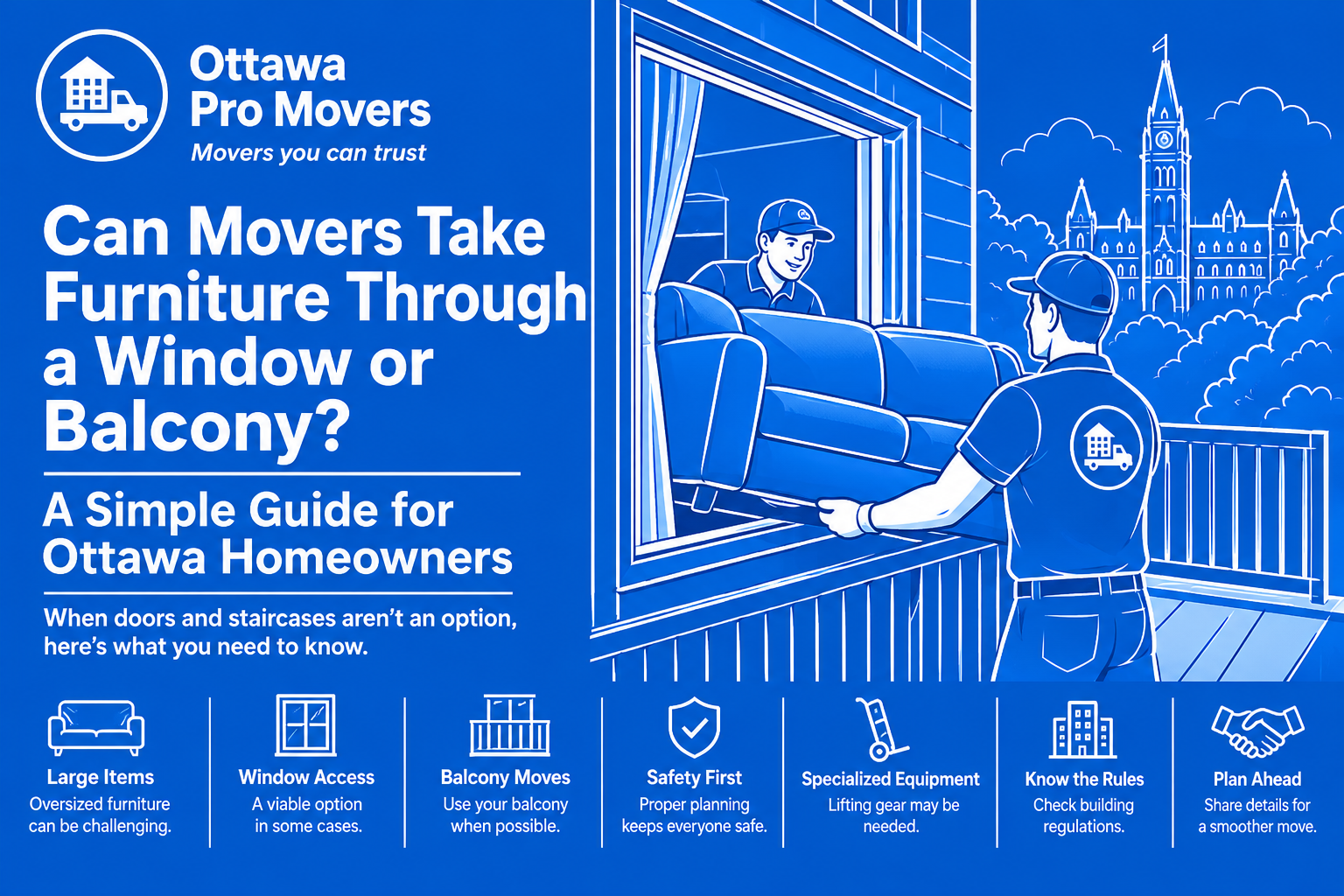
Can Movers Take Furniture Through a Window or Balcony? | Ottawa Pro Movers
Have you ever looked at your oversized sofa, walked over to your staircase, and thought, "There is absolutely no way this is going to fit"?
You're not alone! It's a situation that happens more often than people realize. Large sectionals, king-size mattresses, oversized furniture, and bulky appliances can sometimes be difficult or even impossible to move through traditional doorways, hallways, and staircases.
But does that mean you're out of options?
Not necessarily. In some situations, moving furniture through a window or balcony can be a practical alternative. Professional movers may be able to use an alternative access point to get large items in or out of a property when the usual route simply isn't suitable.
However, moving furniture through a window or balcony is not as simple as opening a window and lifting a sofa. There are several important factors to consider, including the size of the furniture, the height of the property, access conditions, safety requirements, and the equipment needed.
If you're planning a move in Ottawa and wondering whether your furniture can be taken out through a window or balcony, here's what you should know.
Why Would Furniture Need to Go Through a Window or Balcony?
Most residential moves follow a fairly straightforward route. Furniture leaves the room, passes through the doorway, travels along a hallway or staircase, and eventually reaches the moving truck.
But not every home is designed with large furniture in mind.
Some older Ottawa homes have narrow staircases, tight corners, and small doorways that make moving oversized items particularly challenging. Condominiums and apartment buildings can present different difficulties, especially when elevators are small or hallway access is restricted.
Imagine trying to move a large sectional sofa out of a third-floor apartment. The sofa might fit comfortably in the living room, but the hallway turns are too tight, and the elevator is simply too small.
You could try removing the sofa's legs or separating its sections, but sometimes even that isn't enough.
This is where alternative access may become an option.
A sufficiently large window, balcony door, or another suitable exterior opening might provide a more practical route for removing or delivering the furniture.
It's also worth remembering that this isn't only relevant when moving out. Sometimes furniture needs to be brought into a new property through an alternative entrance because the regular access route is too restrictive.
Can Movers Actually Lift Furniture Through a Window?
Yes, in certain circumstances, but it depends heavily on the property and the equipment available.
Moving furniture through a window can involve carefully positioning the item, protecting surrounding surfaces, and determining how it can be safely transferred between the interior and exterior of the building.
For ground-floor properties, the process may be relatively straightforward if the window opening is large enough and there is safe exterior access.
Higher floors are considerably more complicated.
A large sofa or wardrobe cannot simply be lifted out of a second- or third-floor window by a couple of movers standing inside the room. The weight, dimensions, height, and surrounding obstacles all need to be considered.
Depending on the circumstances, specialized equipment or a professional furniture hoisting service may be necessary.
This is particularly important because ordinary moving equipment, such as dollies, moving straps, and furniture blankets, is not automatically suitable for lifting heavy objects outside a building.
A professional moving company should assess the situation before confirming whether this type of move is possible.
What About Moving Furniture Through a Balcony?
Balconies can sometimes provide a more convenient alternative to traditional entrances, especially in apartment buildings and condominiums.
For example, a balcony might have a wider opening than the apartment's main doorway, or it may provide more direct access to the room where the furniture is located.
However, having a balcony doesn't automatically mean that furniture can be lifted over the railing.
There are several things to consider.
First, the balcony itself must be suitable for the proposed operation. Its dimensions, structural limitations, railing design, and available working space all matter.
Second, the furniture needs to be transported safely from the balcony to the ground or another appropriate access point. This may require specialized lifting equipment and qualified professionals.
Building management may also have specific restrictions regarding exterior lifting, balcony access, equipment placement, and work around the building.
For condominium residents in Ottawa, checking with property management before making arrangements is especially important. Some buildings have strict rules about exterior work and may require advance approval.
Which Furniture Items Are Most Likely to Require Alternative Access?
Large furniture is usually the biggest challenge.
Oversized sectional sofas are a common example. Some sectionals have removable sections, but others have large fixed frames that are difficult to manoeuvre around tight corners.
Large wardrobes and armoires can also present problems, particularly when they cannot be fully disassembled. Their height and depth can make them difficult to rotate through narrow hallways.
King-size mattresses, large bed frames, oversized dining tables, and certain entertainment units may also require additional planning.
Pianos are another example. Depending on their size and type, moving them can require specialized equipment, additional expertise, and a carefully planned access route.
Even seemingly ordinary furniture can become difficult to move when the property has unusual architectural features.
The important thing is not simply how heavy an item is. Its dimensions, shape, ability to be disassembled, and the space available along the moving route all influence how it can be transported.
What Do Movers Check Before Attempting a Window or Balcony Move?
Before deciding whether furniture can be moved through an alternative opening, movers need to understand the entire situation.
One of the first things to consider is the furniture itself. Its exact dimensions are important, including its height, width, depth, and overall shape. A sofa that measures eight feet in length may fit through an opening in one orientation but not another.
The opening also needs to be measured accurately. A window's advertised dimensions are not necessarily the same as its actual usable opening. Window frames, handles, screens, and other architectural features can reduce the available space.
The surrounding area matters just as much. Movers need to understand the height of the opening, the distance to the ground, the location of balconies or neighbouring structures, and whether there is sufficient exterior access.
They also need to consider the weight and balance of the furniture. An item that is relatively easy to carry through a hallway can become much more difficult to control when it needs to be lifted outside.
Finally, safety and permissions must be considered. The proposed method needs to be appropriate for the building, the equipment, and the people involved.
Sometimes, after reviewing everything, the best decision is to use a specialized hoisting service rather than attempt to complete the job using standard moving equipment.
Why DIY Window Furniture Moves Can Be Dangerous
It might be tempting to try lifting a large piece of furniture through a balcony or window yourself, especially if you're trying to avoid the cost of specialized services.
However, this is one situation where improvising can create serious problems.
Furniture is often heavier and more awkward to handle than it appears. When an item is lifted outside a building, even a small loss of control can result in serious injury or property damage.
There is also the risk of damaging window frames, railings, exterior walls, glass, and the furniture itself.
Balcony railings are not designed to function as lifting equipment, and leaning over them while handling heavy objects can be extremely dangerous.
Professional movers can help assess the situation and determine whether a standard moving approach is sufficient or whether a specialized service is required.
If exterior lifting is necessary, it should be handled by qualified professionals using appropriate equipment and safety procedures.
Can a Moving Company in Ottawa Arrange This Service?
This depends on the moving company's equipment, experience, and the complexity of the job.
A residential moving crew can often help with difficult furniture access, including disassembling items where appropriate, protecting furniture, and navigating tight interior spaces.
However, lifting furniture from elevated balconies or windows is a different type of operation.
Not every moving company provides professional hoisting or exterior lifting services. In more complicated situations, coordination with a specialized furniture hoisting company may be necessary.
For Ottawa residents, this can be particularly relevant when moving into older downtown properties, multi-storey apartment buildings, and condominiums with limited elevator access.
The earlier you discuss the situation with your moving company, the easier it is to determine what services and arrangements may be needed.
How to Prepare If You Think Your Furniture Won't Fit
If you already suspect that a particular piece of furniture won't fit through your doorway, don't wait until moving day to mention it.
Start by measuring the furniture and comparing its dimensions with the doorways, hallways, staircases, and elevator openings along the planned route.
Take photographs of any particularly tight areas. A picture of a narrow staircase, an awkward hallway turn, or a small elevator can provide useful information when discussing your move.
If you think a window or balcony might be the only possible access point, take photographs from both inside and outside the property, if it is safe and possible to do so.
For condominium moves, contact building management to ask about exterior access restrictions and whether special approval is required.
Most importantly, tell your moving company about the potential issue when requesting a quote. This gives everyone more time to assess the situation and arrange an appropriate solution.
Sometimes, the Best Solution Is Not the Most Obvious One
Moving a large piece of furniture doesn't always mean taking it apart, squeezing it through a doorway, or finding the strongest people available to carry it.
Sometimes, the solution involves changing the route entirely.
A window or balcony may provide an alternative access point, but whether it's practical depends on the furniture, the building, and the equipment required.
For some moves, a little extra planning is all that's needed. For others, specialized lifting equipment and additional professional services may be necessary.
The key is to identify the challenge before moving day rather than discovering it when the moving truck is already outside.
Planning a Move in Ottawa? Let's Talk About Your Furniture
At Ottawa Pro Movers, we know that every home and every move comes with its own challenges. Narrow staircases, tight hallways, small elevators, oversized furniture, and difficult access points are all important details when planning a residential move.
If you have a piece of furniture that you're worried won't fit through a doorway or staircase, let us know in advance.
Share its approximate dimensions and a few photographs of the access areas. We'll help assess the situation and discuss the most practical approach for your move.
And if the job requires specialized exterior hoisting, we'll help you understand what additional arrangements may be needed.
Our goal is simple: to make your move as smooth, safe, and well-planned as possible.
Planning a move in Ottawa? Contact Ottawa Pro Movers for a moving quote and let us help you figure out the best way to get your furniture from one home to the next.